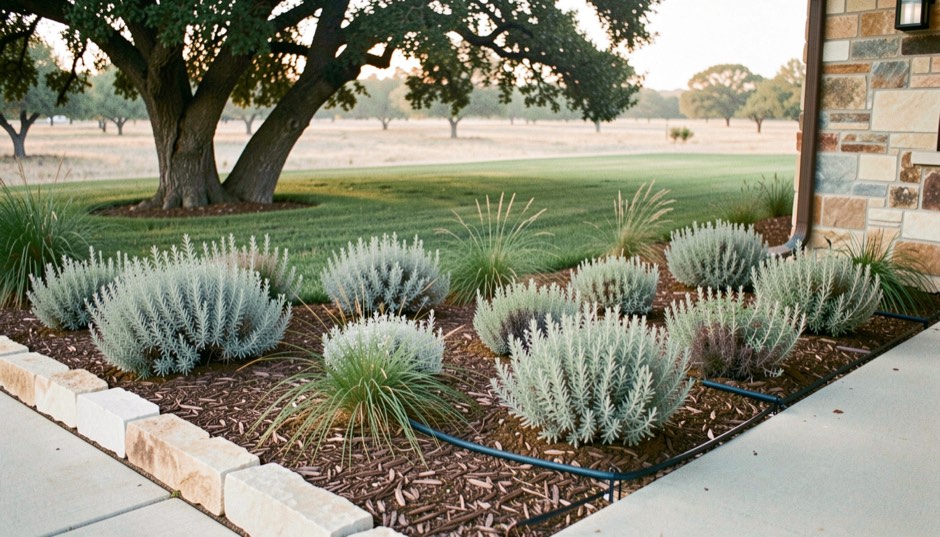
Water-smart landscaping in New Braunfels means designing a yard that keeps working when New Braunfels Utilities (NBU) limits sprinklers and irrigation systems to one day a week. The city's conservation stages follow the level of the Edwards Aquifer and the flow of Comal Springs, so a sound plan starts from three local facts: your watering day, your soil, and how your irrigation zones are split. Plants come after that. NBU's posted stage has been Stage 2 since August 10, 2026.
The general method is the same as anywhere: observe the site, group plants by need, and give water only where it does useful work. Our guide to water-smart landscape design sets out that sequence. This page adds what is specific to a New Braunfels lot, using what NBU and the Handbook of Texas publish.
Why is water-smart landscaping different in New Braunfels?
New Braunfels sits on an unusual water story. The Handbook of Texas describes Comal Springs, on the northwestern edge of the city, as the largest group of natural springs in Texas. Their water filters through the Edwards and associated limestones and rises along the Comal Springs fault, feeding Landa Lake and the Comal River. The same entry notes that the flow, and the plant and animal life it supports, is threatened by the falling level of the aquifer.
That link between aquifer, springs and city is written into the watering rules. NBU's drought stages are triggered either by the aquifer level, measured in feet above mean sea level as a ten-day rolling average reported by the Edwards Aquifer Authority, or by Comal Springs flow in cubic feet per second, whichever passes its threshold first. A New Braunfels yard is therefore planned for a supply that tightens in dry spells, not for an average year. The mayor declares each stage in consultation with NBU, and the revised drought contingency plan now runs to Stage 5.
What do NBU's conservation stages allow for landscape watering?
The table below summarises the first three stages as NBU posted them in October 2026. Rules can change when a stage is declared or the plan is revised, so check the current conservation stage before setting a controller.
| Stage | Trigger, whichever comes first | Sprinklers and irrigation systems | Hand-held hose, bucket, drip or soaker hose |
|---|---|---|---|
| Stage 1 | Aquifer at or below 660 ft above sea level, or Comal Springs at or below 225 cfs | Once a week on the address day, before 10 a.m. or after 8 p.m. | Any day, any hour |
| Stage 2 | Aquifer at or below 650 ft above sea level, or Comal Springs at or below 200 cfs | Once a week on the address day, before 10 a.m. or after 8 p.m. | Any day, before 10 a.m. or after 8 p.m. |
| Stage 3 | Aquifer at or below 640 ft above sea level, or Comal Springs at or below 150 cfs | Once a week on the address day | Any day, before 10 a.m. or after 8 p.m. |
The address day comes from the last digit of the street number: Monday for 0 or 1, Tuesday for 2 or 3, Wednesday for 4 or 5, Thursday for 6 or 7, and Friday for 8 or 9. In Stage 2, foundations may also be watered for up to two hours on any day during the watering hours, by hand-held hose or by a soaker or drip line within 24 inches of the foundation that does not spray above ground. The plan adds surcharges on irrigation use in the higher stages, and NBU states that customers who use less than 6,000 gallons a month are not charged drought surcharges.
Which side of the Balcones Escarpment is your yard on?
Comal County lies on the divide between the Blackland Prairies and the Balcones Escarpment, according to the Handbook of Texas entry for Comal County. The eastern quarter, below the escarpment, is gently rolling land at 600 to 750 feet, with Blackland Prairie loam over clay subsoils. The northwestern three-quarters climbs from about 750 to roughly 1,500 feet, with loam that varies from shallow to deep and a Hill Country cover of live oak, mesquite and Ashe juniper.
The difference matters before any plant is chosen. A clay subsoil takes water slowly, so a long sprinkler run on the one permitted day can end as runoff on the sidewalk rather than water in the root zone. A shallow soil over rock holds little, so plants there depend on what the bed can store between watering days. Dig a few test holes, note how deep the soil goes, and watch how a slow soak behaves before deciding on turf, beds or a gravel garden. A landscape site analysis checklist gives those observations a place, alongside sun, slope and access.
The county record also gives two planning numbers: annual precipitation averaging 33.19 inches and a growing season of 265 days. A season that long means a planting plan has to carry its beds through the hottest months on the permitted schedule, not only through a mild spring.
How do you design a yard around one irrigation day a week?
Start with the irrigation zones, because they decide what the rules let you do. A sprinkler zone gets one window a week in the current stage, while beds on drip or soaker lines can be watered on any day inside the morning and evening hours. That single difference suggests a layout: keep spray irrigation for the turf you actually use, and put shrubs, perennials and young trees on drip.
- Group plants by water need, so each zone serves plants that want the same schedule. A thirsty bed sharing a valve with tough shrubs forces you to water both for the weaker one.
- Size the lawn to its use: a play area or a path to the gate, not every open square foot. Grass that nobody walks on still claims the weekly sprinkler run.
- Take out zones you no longer need. NBU's irrigation page names incorrect pressure, overspray and inefficient scheduling as causes of waste, and offers short videos on programming controllers and on pressure-regulating sprinkler heads.
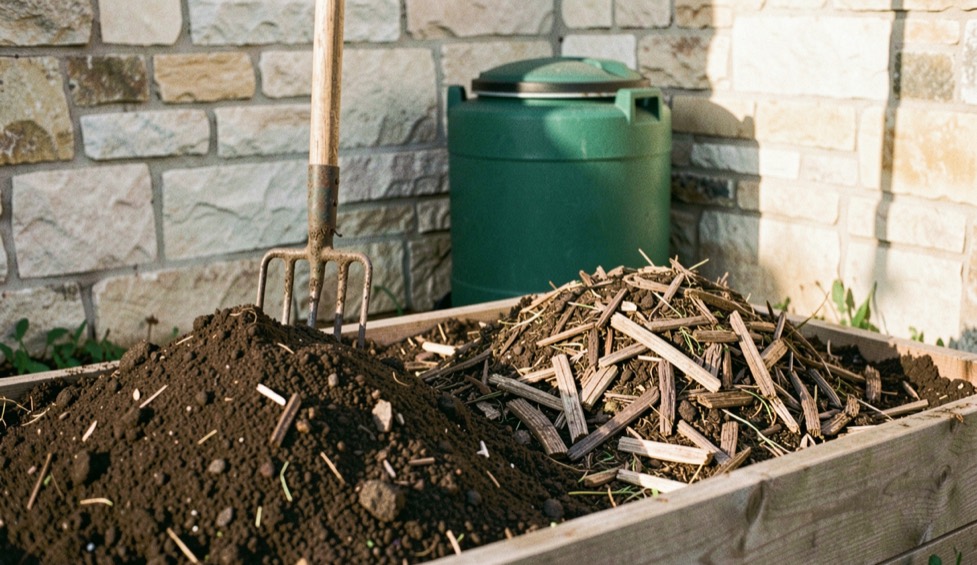
- Build soil and mulch into the plan, since a bed that holds water between watering days asks less of the system.
- Plan the foundation strip on its own. Stage 2 allows foundation watering by hand-held hose or by a drip or soaker line within 24 inches of the foundation, so a dedicated low-volume line there keeps that task off the lawn zone.
NBU also offers a free assessment for residential and commercial customers, which reviews usage against local averages and can cover the irrigation controller. Booking one before a redesign gives you a baseline to compare against afterwards.
Which NBU rebates fit a water-smart redesign?
NBU lists several landscape rebates on its rebates page. The maximum amounts below are those shown in October 2026. Each rebate has an application form with its own conditions, so read the form before removing grass or capping a zone.
- Grass removal: up to $2,000 for removing high-water-use turfgrass at a home or business.
- Irrigation zone removal: $250 per zone, up to $2,500, for taking unused zones out of service.
- Rain barrel or cistern: up to $2,500 for collecting rainwater for outdoor use.
- Healthy soil: up to $130 for mulch, compost or core aeration that improves water retention and reduces runoff.
- Drought-tolerant tree: up to $500, residential customers only, for a qualifying tree.
- Comal County Gardening Guide: up to $40, residential customers only, toward a guide on planting and maintaining a drought-tolerant landscape in Comal County.
Rain capture is easy to size on paper. One inch of rain on 1,000 square feet of roof is about 623 gallons, so a 50-gallon barrel on a downspout that drains that area fills from less than a tenth of an inch of rain. Storage, not rainfall, is usually the limit. Place it where it can feed the beds on drip, since those are the areas you can water on any day.
What goes into a one-page landscape water plan?
A landscape water management plan for a single home does not need to be long. One page that a designer, an irrigation contractor or a family member can read is enough, and it should record:
- Your address digit, your watering day and the stage in force on the date you write it.
- Each irrigation zone, what it waters, and whether it is spray, drip or soaker.
- Soil notes from the test holes, and the side of the escarpment the lot sits on.
- Monthly readings from the water or irrigation meter, so changes can be measured.
- The rebates you intend to apply for, with each form read before work starts.
- Open questions for a professional, such as grading near the foundation or a new zone layout.
NBU publishes a guide to reading an irrigation meter, which makes the fourth line easy to keep. When you meet a designer, bring the page and use our list of questions to ask a landscape designer to check how they would handle the watering day, the zones and the soil.
Questions homeowners ask
Can I water my New Braunfels yard with a drip system on any day?
Under NBU's Stage 2 rules posted in October 2026, drip irrigation, soaker hoses, hand-held hoses and buckets may be used on any day, but only before 10 a.m. or after 8 p.m. Sprinklers and irrigation systems are limited to one day a week, set by the last digit of the street address.
What decides the drought stage in New Braunfels?
NBU's stages are triggered by the Edwards Aquifer level, taken as a ten-day rolling average in feet above mean sea level, or by Comal Springs flow, whichever crosses its threshold first. Stage 2, for example, begins at 650 feet or 200 cubic feet per second. The mayor declares a stage in consultation with NBU.
Does NBU pay homeowners to remove grass?
Yes. In October 2026 NBU's rebates page listed a grass removal rebate of up to $2,000, alongside rebates for removing irrigation zones, rain barrels or cisterns, healthy soil, drought-tolerant trees and the Comal County Gardening Guide. Each rebate has an application form with its own conditions.
Source ledger
What supports this guide
- nbutexas.com/ways-to-save/water/current-conservation-stage informs the planning questions here. Local authorities control site-specific rules.
- nbutexas.com/ways-to-save/rebates informs the planning questions here. Local authorities control site-specific rules.
- tshaonline.org/handbook/entries/comal-county informs the planning questions here. Local authorities control site-specific rules.
- tshaonline.org/handbook/entries/comal-springs informs the planning questions here. Local authorities control site-specific rules.
Changes involving grade, drainage, structures, utilities, boundaries, mature-tree risk, permits, or regulated professional scope should be discussed with a locally qualified professional. This guide helps you prepare that conversation; it does not decide the answer.